


Page 8 - Demo
P. 8
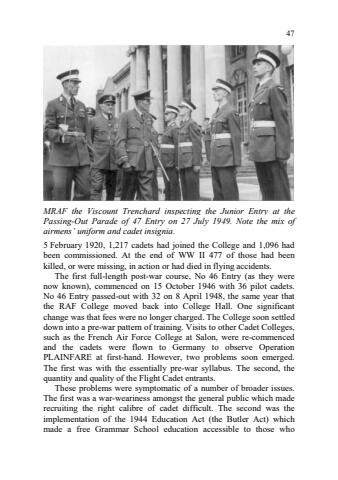
475 February 1920, 1,217 cadets had joined the College and 1,096 had been commissioned. At the end of WW II 477 of those had been killed, or were missing, in action or had died in flying accidents. The first full-length post-war course, No 46 Entry (as they were now known), commenced on 15 October 1946 with 36 pilot cadets. No 46 Entry passed-out with 32 on 8 April 1948, the same year that the RAF College moved back into College Hall. One significant change was that fees were no longer charged. The College soon settled down into a pre-war pattern of training. Visits to other Cadet Colleges, such as the French Air Force College at Salon, were re-commenced and the cadets were flown to Germany to observe Operation PLAINFARE at first-hand. However, two problems soon emerged. The first was with the essentially pre-war syllabus. The second, the quantity and quality of the Flight Cadet entrants. These problems were symptomatic of a number of broader issues. The first was a war-weariness amongst the general public which made recruiting the right calibre of cadet difficult. The second was the implementation of the 1944 Education Act (the Butler Act) which made a free Grammar School education accessible to those who MRAF the Viscount Trenchard inspecting the Junior Entry at the Passing-Out Parade of 47 Entry on 27 July 1949. Note the mix of airmens%u2019 uniform and cadet insignia.


