


Page 7 - Demo
P. 7
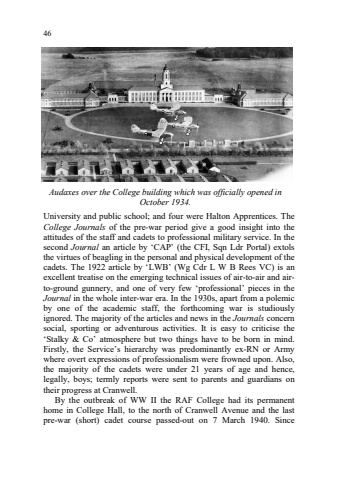
46University and public school; and four were Halton Apprentices. The College Journals of the pre-war period give a good insight into the attitudes of the staff and cadets to professional military service. In the second Journal an article by %u2018CAP%u2019 (the CFI, Sqn Ldr Portal) extols the virtues of beagling in the personal and physical development of the cadets. The 1922 article by %u2018LWB%u2019 (Wg Cdr L W B Rees VC) is an excellent treatise on the emerging technical issues of air-to-air and airto-ground gunnery, and one of very few %u2018professional%u2019 pieces in the Journal in the whole inter-war era. In the 1930s, apart from a polemic by one of the academic staff, the forthcoming war is studiously ignored. The majority of the articles and news in the Journals concern social, sporting or adventurous activities. It is easy to criticise the %u2018Stalky & Co%u2019 atmosphere but two things have to be born in mind. Firstly, the Service%u2019s hierarchy was predominantly ex-RN or Army where overt expressions of professionalism were frowned upon. Also, the majority of the cadets were under 21 years of age and hence, legally, boys; termly reports were sent to parents and guardians on their progress at Cranwell. By the outbreak of WW II the RAF College had its permanent home in College Hall, to the north of Cranwell Avenue and the last pre-war (short) cadet course passed-out on 7 March 1940. Since Audaxes over the College building which was officially opened in October 1934.


