


Page 6 - Demo
P. 6
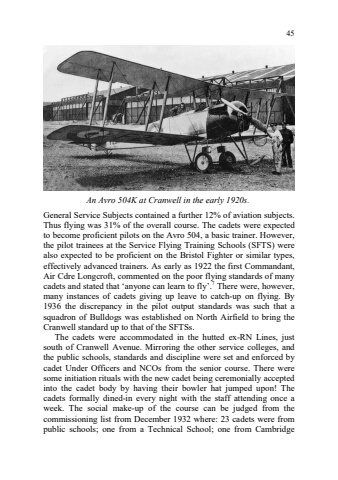
45General Service Subjects contained a further 12% of aviation subjects. Thus flying was 31% of the overall course. The cadets were expected to become proficient pilots on the Avro 504, a basic trainer. However, the pilot trainees at the Service Flying Training Schools (SFTS) were also expected to be proficient on the Bristol Fighter or similar types, effectively advanced trainers. As early as 1922 the first Commandant, Air Cdre Longcroft, commented on the poor flying standards of many cadets and stated that %u2018anyone can learn to fly%u2019.7 There were, however, many instances of cadets giving up leave to catch-up on flying. By 1936 the discrepancy in the pilot output standards was such that a squadron of Bulldogs was established on North Airfield to bring the Cranwell standard up to that of the SFTSs. The cadets were accommodated in the hutted ex-RN Lines, just south of Cranwell Avenue. Mirroring the other service colleges, and the public schools, standards and discipline were set and enforced by cadet Under Officers and NCOs from the senior course. There were some initiation rituals with the new cadet being ceremonially accepted into the cadet body by having their bowler hat jumped upon! The cadets formally dined-in every night with the staff attending once a week. The social make-up of the course can be judged from the commissioning list from December 1932 where: 23 cadets were from public schools; one from a Technical School; one from Cambridge An Avro 504K at Cranwell in the early 1920s.


