


Page 4 - Demo
P. 4
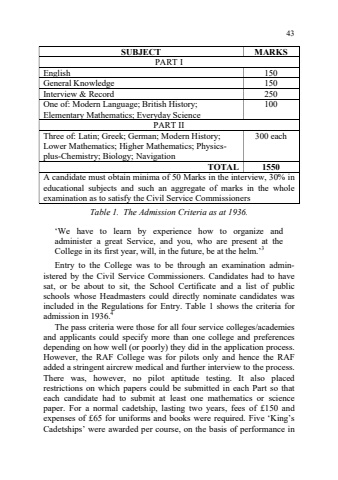
43%u2018We have to learn by experience how to organize and administer a great Service, and you, who are present at the College in its first year, will, in the future, be at the helm.%u20193 Entry to the College was to be through an examination administered by the Civil Service Commissioners. Candidates had to have sat, or be about to sit, the School Certificate and a list of public schools whose Headmasters could directly nominate candidates was included in the Regulations for Entry. Table 1 shows the criteria for admission in 1936.4 The pass criteria were those for all four service colleges/academies and applicants could specify more than one college and preferences depending on how well (or poorly) they did in the application process. However, the RAF College was for pilots only and hence the RAF added a stringent aircrew medical and further interview to the process. There was, however, no pilot aptitude testing. It also placed restrictions on which papers could be submitted in each Part so that each candidate had to submit at least one mathematics or science paper. For a normal cadetship, lasting two years, fees of %u00a3150 and expenses of %u00a365 for uniforms and books were required. Five %u2018King%u2019s Cadetships%u2019 were awarded per course, on the basis of performance in SUBJECT MARKSPART IEnglish 150General Knowledge 150Interview & Record 250One of: Modern Language; British History; Elementary Mathematics; Everyday Science100PART IIThree of: Latin; Greek; German; Modern History; Lower Mathematics; Higher Mathematics; Physicsplus-Chemistry; Biology; Navigation300 eachTOTAL 1550A candidate must obtain minima of 50 Marks in the interview, 30% in educational subjects and such an aggregate of marks in the whole examination as to satisfy the Civil Service CommissionersTable 1. The Admission Criteria as at 1936.


