


Page 10 - Demo
P. 10
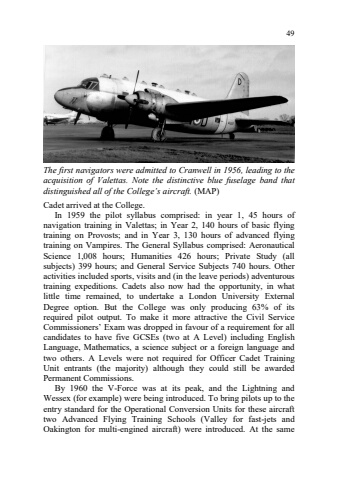
49Cadet arrived at the College. In 1959 the pilot syllabus comprised: in year 1, 45 hours of navigation training in Valettas; in Year 2, 140 hours of basic flying training on Provosts; and in Year 3, 130 hours of advanced flying training on Vampires. The General Syllabus comprised: Aeronautical Science 1,008 hours; Humanities 426 hours; Private Study (all subjects) 399 hours; and General Service Subjects 740 hours. Other activities included sports, visits and (in the leave periods) adventurous training expeditions. Cadets also now had the opportunity, in what little time remained, to undertake a London University External Degree option. But the College was only producing 63% of its required pilot output. To make it more attractive the Civil Service Commissioners%u2019 Exam was dropped in favour of a requirement for all candidates to have five GCSEs (two at A Level) including English Language, Mathematics, a science subject or a foreign language and two others. A Levels were not required for Officer Cadet Training Unit entrants (the majority) although they could still be awarded Permanent Commissions. By 1960 the V-Force was at its peak, and the Lightning and Wessex (for example) were being introduced. To bring pilots up to the entry standard for the Operational Conversion Units for these aircraft two Advanced Flying Training Schools (Valley for fast-jets and Oakington for multi-engined aircraft) were introduced. At the same The first navigators were admitted to Cranwell in 1956, leading to the acquisition of Valettas. Note the distinctive blue fuselage band that distinguished all of the College%u2019s aircraft. (MAP)


